The client: Dresden University of Applied Sciences
With almost 5,000 students and around 870 employees, HTW Dresden is the second largest university in the city of Dresden. Founded in 1992, shortly after reunification, it quickly established itself and now offers 36 degree programmes in eight faculties. Internationally, HTW Dresden is connected with around 145 universities, promoting the exchange of students and teaching staff.

HTW Dresden App
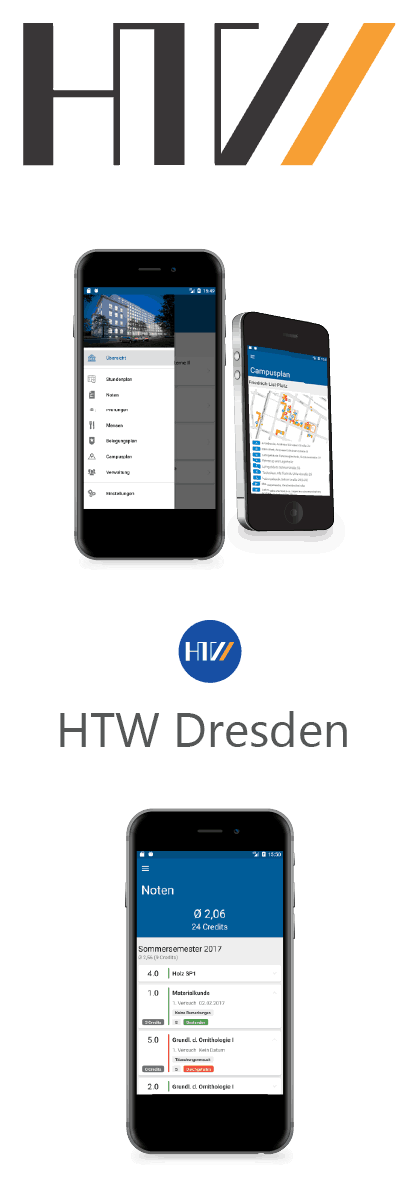
A new app was developed for the students of the Dresden University of Applied Sciences (HTW). With the HTW Dresden app, students keep track of their achievements, upcoming exams, the canteen menu and campus life in general – true to the university's motto: "practically achieve more".
The app: the content
The app requires a login to access personal data. A clearly structured menu gives quick and easy access to the different areas of the app. The current version has seven areas, plus an overview of the most important content and settings to adapt the app to each student's daily routine.
In the various areas, students can view important information about their studies and everyday student life. First of all, this is the personal timetable, shown as a list – the app determines the data automatically from the student's study group. Students can also view their grades, examination results and credits earned, check upcoming exam dates, search the room allocation plan for rooms and the courses taking place in them, use a campus map for orientation and look up general information about the university and its degree programmes – for example the opening hours of the various facilities and lecture-free periods. A popular feature is access to the menus and prices of the nearby canteens via an OpenMensa connection.
The app: the technology
The HTW Dresden app is available for Android and iOS devices. Technologically, there are some differences between the two versions. While Apple supports Objective-C and Swift for iOS apps, Android apps are developed in Java or Kotlin. The features of the programming languages, the supported libraries and the program architectures differ more or less on the two systems. Both operating systems, however, are actively developed and have a very high technological standard. The app reflects the current state of the art on each platform and is available free of charge in the Apple App Store and the Google Play Store.
Special features of the iOS app
Especially when processing data streams over networks, reacting to user interactions without delay requires asynchrony, as the app would otherwise block until a response arrives. The keyword here is "reactive programming". Reactive Extensions (also ReactiveX or RX) provide a mature API for these use cases. The iOS app uses the Swift variant. RxSwift also makes it possible to design the app's architecture cleanly and to use a model that goes beyond MVC (Model-View-Controller). The HTW Dresden app was developed following the MVVM-C pattern (Model-View-ViewModel-Coordinator). This cleanly separates logic and views and makes further development easier.
Moya is used as the network abstraction layer. This intermediate step contributes to a clean structure of the app and simplifies future maintenance. The data is stored locally in a REALM database, the fastest mobile database available.
Animations implemented with the cross-platform library Lottie provide a certain wow effect, enabling the app to render Adobe After Effects animations smoothly on mobile devices as well.
The programming language is Swift in the current version 5.0. Apple now recommends using the more modern Swift instead of Objective-C for app development, and Swift can make use of everything Apple's devices offer. As development never stands still, the declared goal for all apps is to keep them optimised for the state of the art – in this case iOS 13. Among other things, this operating system version introduced dark mode, which the HTW Dresden app fully supports.
Special features of the Android app
On Android, the app should be of the same quality as on iOS. In some places, the methods or libraries used differ due to the platform.
Asynchronous programming with RX remains the same, though here the Kotlin version is used instead of the Swift variant. Lottie is the tool of choice for animations on Android too. As on iOS, a REALM database stores the data locally. The internal data structure is therefore identical on both platforms, which reduces the effort during development and future maintenance. Similar to the iOS implementation, there is also a network abstraction layer here: Retrofit.
Architecturally, the Android app relies on the MVVM pattern to separate logic and views cleanly – similar to, but somewhat simpler than MVVM-C on iOS. The app was developed natively in Kotlin, which Google has officially preferred for Android app development since May 2019. In addition, the Android Jetpack Components are used, which simplify in-app navigation and real-time data display.